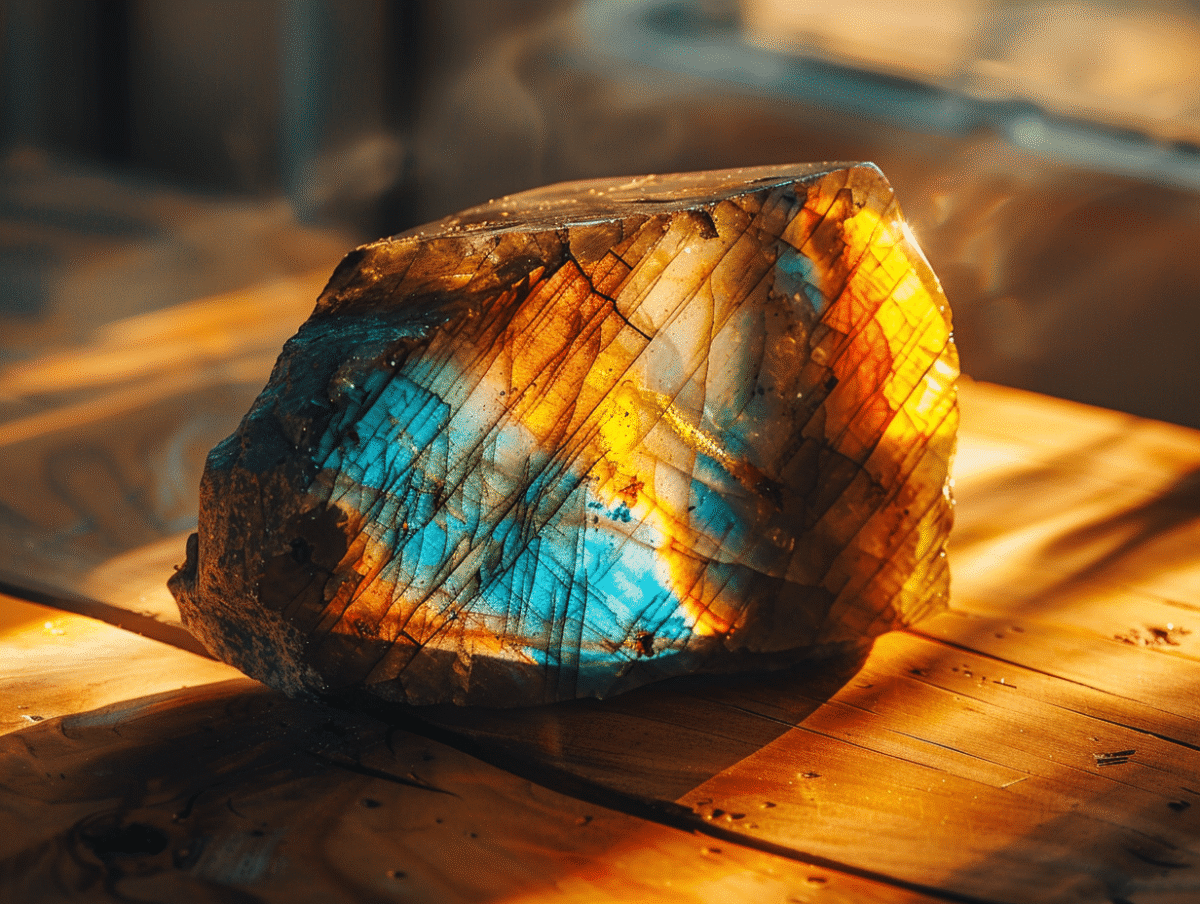
Labradorite, a stone with iridescent reflections, has captivated the imagination since its discovery in the 18th century on the Labrador Peninsula in Canada. This mineral, ranging from shades of gray to deep blue, is surrounded by mysteries and legends. Beyond its aesthetic appeal, it is attributed with virtues in the field of lithotherapy, where it is said to act as a powerful protector against negative energies and to enhance intuition. Scientists, on the other hand, are fascinated by its unique physical properties, particularly its labradorescence, an optical phenomenon responsible for its shimmering colors. This dichotomy between popular beliefs and scientific interest fuels the mystery surrounding labradorite.
The hidden truths behind the properties of labradorite
At the heart of the debates surrounding labradorite, a fine stone from the feldspar family, lie its energetic and therapeutic properties. Many lithotherapy enthusiasts attribute protective capabilities against negative energies to this stone. In this vein of thought, labradorite stands as a shield, warding off ailments and emotional imbalances. Labradorite bracelets, often worn, are said to serve as talismans, channeling these purported properties. However, while the virtues of labradorite are appealing, it is important not to overlook the necessity of its purification and recharging, recurring practices that support its effectiveness according to popular beliefs.
The labradorite stone, associated with various chakras, notably the root chakra, heart chakra, throat chakra, and third eye chakra, is said to harmonize these energy centers. It is believed to play a role in emotional and spiritual balance. At the intersection of beliefs and science, the relationship between labradorite and the chakras remains a subject of speculation, as empirical research has not confirmed these links. Nevertheless, gem enthusiasts, from obsidian to tourmaline, recognize labradorite’s special place in the hearts of collectors and lithotherapy practitioners.
Beyond practices, labradorite is of interest for its extraction and international trade. From Canada, its place of discovery, to deposits in Madagascar and France, labradorite crosses borders to reach showcases and workshops. Some warn against potential labradorite: negative effects related to over-extraction or irresponsible marketing. The quest for this stone, whose brilliance fascinates, must be part of an environmentally respectful approach and consideration for local communities, a sine qua non condition for its magic to endure.

Scientific and symbolic exploration of labradorite
In the field of lithotherapy, labradorite is often invoked for its energetic properties and its ability to harmonize the chakras. This practice, rooted in millennia-old beliefs, suggests that labradorite positively impacts humans by acting on specific energy centers, such as the third eye chakra and the throat chakra. The latter, linked respectively to intuition and communication, would be influenced by the presence and use of this stone. Science, while remaining cautious, observes these practices with interest, seeking to decipher the link between minerals and the human psyche.
Astrologically, labradorite resonates with certain zodiac signs, notably Pisces, Cancer, and Scorpio. For astrology enthusiasts, these associations are not coincidental: they reflect an affinity between the symbolic characteristics of the stone and the personality traits attributed to these signs. Labradorite, considered a stone of transformation, is said to support individuals during periods of change and personal development, particularly for those born under these constellations.
The product sheet of labradorite in the world of gemology highlights another fascinating aspect of this stone: its ability to protect against electromagnetic waves. Although this specific point remains controversial in scientific circles, some users and Feng Shui practitioners attribute protective virtues to labradorite against these omnipresent waves in our modern environment. In this context, labradorite, like black tourmaline, is incorporated into jewelry, such as necklaces, or placed in living spaces to contribute to a domestic energetic balance.