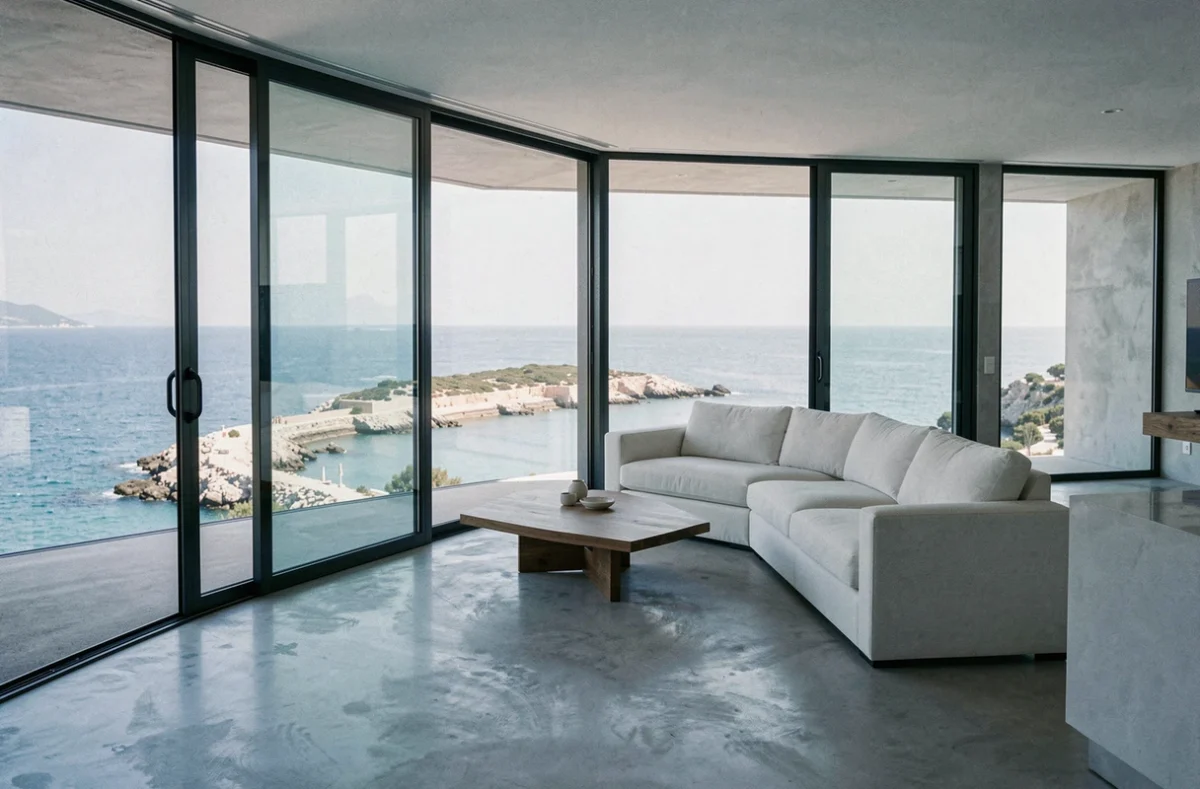
In the coastal real estate market, the mention of “sea view” in a listing triggers a cost increase that varies significantly from one property to another. Two apartments of the same size, in the same residence, can show a marked price difference depending on the actual quality of that view. Understanding what causes this discrepancy requires breaking down the view into measurable parameters, and then cross-referencing these parameters with legal constraints that most buyers discover too late.
The rest of this article details the technical criteria that weigh most heavily in price formation, starting from the most structural (the angle of view) to the least known (the risk of coastal erosion).
Opening angle and floor: the two variables that structure the price per square meter
The first distinction to make is between panoramic view and sea glimpse. A panoramic view refers to a wide visual field, unobstructed, where the sea occupies most of the landscape visible from the living room. A glimpse, on the other hand, corresponds to a partial view between two buildings or above a neighboring roof.
The valuation gap between these two situations is considerable. An unobstructed panorama from a terrace does not have the same effect on price as a simple angle of sea visible from a side window. Estimation professionals practically distinguish several levels: dominant view (overlooking, with a sense of space and intimacy), unobstructed frontal view, partial lateral view, and simple proximity to the shore without direct visual.
The floor acts as a multiplier. The higher the apartment, the greater the probability of an unobstructed view, and the lower the risk of losing the view due to future construction. A top floor with a terrace facing the open sea represents the most valued configuration in the coastal prestige market.
To delve deeper into the criteria that truly impact the valuation of a coastal property, the analyses published on guide-immo.net for real estate purchase provide a complementary framework for understanding.

Orientation, sunlight, and distance to the shore: what the panorama alone does not convey
An apartment can offer a wide maritime panorama while suffering from a poor orientation. A north-facing sea view loses some of its value compared to a south or west exposure, because the low evening light on the water is one of the most sought-after emotional elements by buyers.
Orientation also affects the thermal comfort of the home, which indirectly influences perceived value. A south-facing balcony overlooking the Mediterranean does not offer the same experience as a façade exposed to the prevailing winds of the English Channel.
Distance to the coast and frequent confusion
A study published on data.gouv.fr, titled “Coastal Line: Does the Seafront Pay for Erosion?”, observes a price gradient based on distance to the coast for properties located less than two kilometers from the shore. However, it specifies that this gradient does not isolate the specific effect of the view: other characteristics vary simultaneously with distance, such as the age of the building or use as a secondary residence.
Proximity to the shore and sea view are therefore not equivalent variables. An apartment set back several hundred meters but located at a height can offer a superior panorama compared to a ground floor apartment on the seafront obscured by a dike.
Risk of erosion and Coastal Law: the criterion that the market underestimates
One of the least discussed angles in estimating a sea view property concerns the regulatory constraints related to the retreat of the coastline. Some municipalities are listed on an official list of areas affected by this phenomenon. In these zones, exposure maps distinguish two time horizons:
- A 30-year horizon, where restrictions on construction and extensions can be significant
- A 30 to 100-year horizon, which may limit heavy renovation or expansion projects
- Obligations to inform the buyer, requiring the seller to mention the property’s exposure to coastline retreat
The same study from data.gouv.fr notes a surprising point: the listing of a municipality on this list does not produce a measurable decrease in prices immediately. However, it specifies that the effect of a subsequently adopted local exposure map has not been measured. In other words, the risk exists but the market has not yet visibly integrated it.
For a buyer, this situation creates a potential trap. An apartment with a sea view purchased at a high price in an exposed area may see its resale value affected if an exposure map restricts the possibilities for renovations or if erosion progresses faster than expected.
Coastal Law and buildability
The Coastal Law strictly regulates urbanization in coastal municipalities. It limits the extension of urbanization in continuity with already built areas and prohibits construction within a hundred-meter band from the shore (except in dense urban areas). These constraints reduce the supply of new properties on the seafront, which mechanically maintains the scarcity of sea view apartments and supports prices.

Overlooking and permanence of the view: the risk of loss of value after purchase
A rarely quantified but crucial criterion in price formation is the permanence of the view. A maritime panorama guaranteed by the topography (cliff, seafront without buildable land below) is structurally worth more than a currently unobstructed view but threatened by a future building permit.
Before purchasing, consulting the local urban planning plan allows verification of building rights on the parcels located between the apartment and the sea. A zone classified as natural or agricultural offers better guarantees than an urban area where a multi-story building could obstruct the view.
- Check the PLU zoning of the intermediate parcels between the property and the coast
- Consult recently filed or granted building permits in the immediate vicinity
- Identify view easements and potential heritage protections (historical monuments, classified sites)
The difference between a permanent view and a precarious view can represent a significant price gap at resale. An informed buyer incorporates this parameter from the initial estimate, not after the signing.
The price of a sea view apartment is not just about the presence of blue in the visual field. The opening angle, floor, orientation, actual distance to the shore, risk of erosion, and legal permanence of the view form a set of criteria, none of which operates in isolation.
The most underestimated parameter is probably the regulatory framework. The exposure maps for coastline retreat, still poorly integrated by the market, could permanently alter the hierarchy of prices in certain segments of the coast.