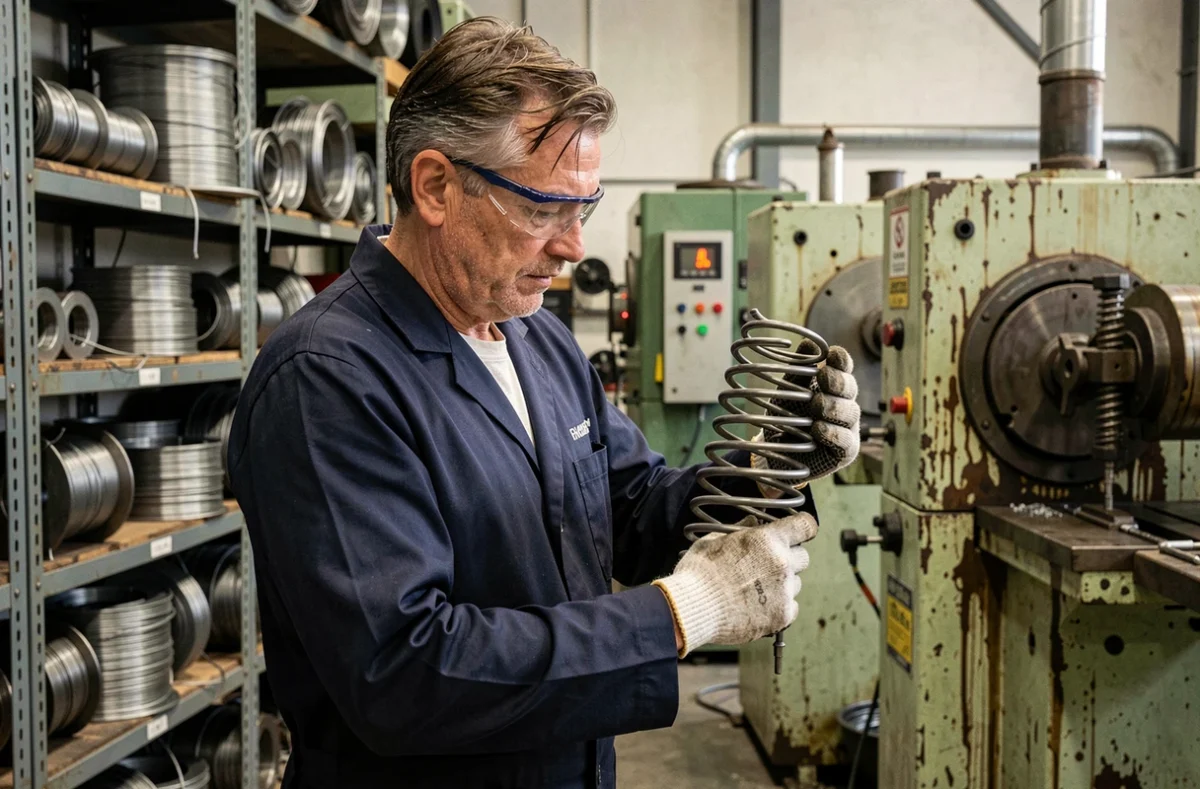
A custom spring is more than just coiled wire. Each part must meet precise specifications (load, fatigue, chemical environment, temperature) and requires skills that the French industry sometimes struggles to replenish. Retirements and a shortage of skilled workers are making it harder for industrial sites to operate, and lost expertise can take years to rebuild.
Wire sourcing and the limits of the local supply chain
The raw material for a spring is wire. Whether it is carbon steel, stainless steel, Inconel or phosphor bronze, the choice of material determines fatigue resistance, temperature performance and behavior in corrosive environments. The wire cross-section, whether round or shaped, directly affects the stiffness and overall dimensions of the finished spring.
Industrial reshoring does not guarantee a fully French supply chain. Some components and grades of steel or alloy remain difficult to source domestically. A French manufacturer often has to choose between a European supplier with predictable lead times and a lower-cost supplier outside Europe, with the associated logistical risks.
Electricity also accounts for a significant share of factory operating costs. Price differences compared with other countries affect the competitiveness of French spring manufacturers, particularly for energy-intensive heat treatments. Customers often underestimate this factor when comparing a quote from France with one from Asia.
This industrial reality explains why Fefa’s expertise in custom spring manufacturing is built on mastering the entire process, from wire selection to final inspection, to reduce reliance on distant intermediaries.
Coiling and forming: critical parameters for custom springs
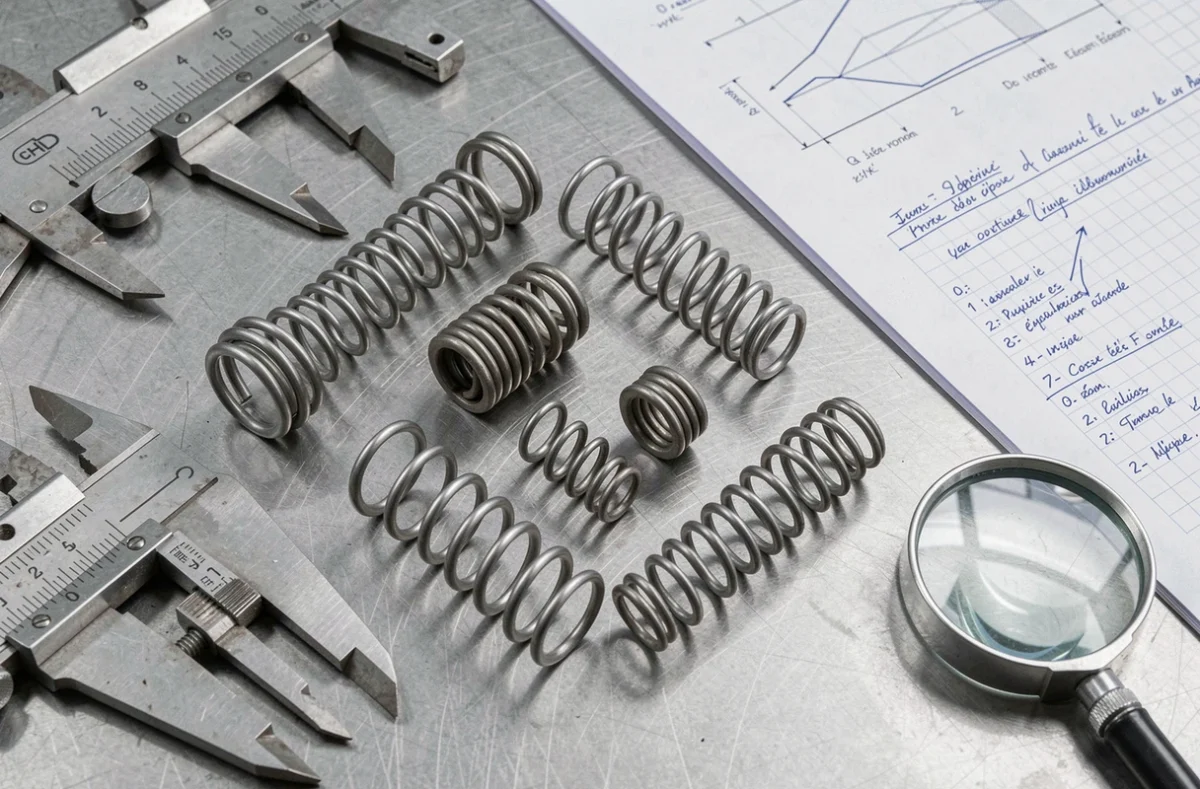
Cold coiling is used for most springs with a small cross-section. The wire passes through a CNC coiling machine that controls the pitch, outside diameter, number of active coils and winding direction (right- or left-hand). A deviation of just a few tenths of a millimeter in the mandrel diameter can measurably change the spring load.
Hot coiling is required for larger wire diameters, typically above ten to twelve millimeters. The wire is heated before forming to reduce internal stresses. This process requires an experienced operator who can judge the wire temperature by eye and adjust the settings in real time.
Coils, pitch and load: the design triangle
The number of active coils determines the spring’s flexibility. The more coils there are, the softer the spring will be, assuming the wire diameter and cross-section remain constant. The pitch (the distance between two consecutive coils) determines the available compression travel.
We find that the most common design errors stem from underestimating the static load or overlooking dynamic fatigue. A spring designed for a given static load can fail after just a few thousand cycles if the alternating stress exceeds the material’s endurance limit.
- Compression spring: helical coils with a constant or variable pitch, used in suspensions, valves and return mechanisms.
- Extension spring: close-wound coils with loops or hooks at the ends, stretched in applications such as industrial doors and safety systems.
- Torsion spring: works by bending around its axis and is commonly used in hinges, clamps and locking mechanisms.
- Shaped springs (conical, double-conical or rectangular-wire): designed to meet space constraints or non-linear load requirements.
Heat and surface treatments for a longer service life
After forming, a spring undergoes a stress-relief heat treatment. This step removes residual stresses introduced during cold coiling. Without it, the spring gradually loses load in service, a phenomenon known as relaxation.
Shot peening is another way to improve durability. High-speed impacts from tiny shot particles create a compressive layer on the wire surface, delaying the onset of fatigue cracks. On an automotive suspension spring, shot peening can significantly extend fatigue life.
Corrosion-resistant coatings
The coating depends on the operating environment. A spring intended for food processing faces different requirements from one used in landing gear.
- Electroplated zinc: standard protection for mildly corrosive indoor environments.
- Zinc flake coating or Geomet: significantly greater resistance to salt spray, suitable for automotive and rail applications.
- Passivation or electropolishing of stainless steel: for food, medical or chemical environments.
- Epoxy paint or e-coating: additional protection for large-diameter springs exposed to the elements.
Skills transfer and industrial continuity in spring manufacturing
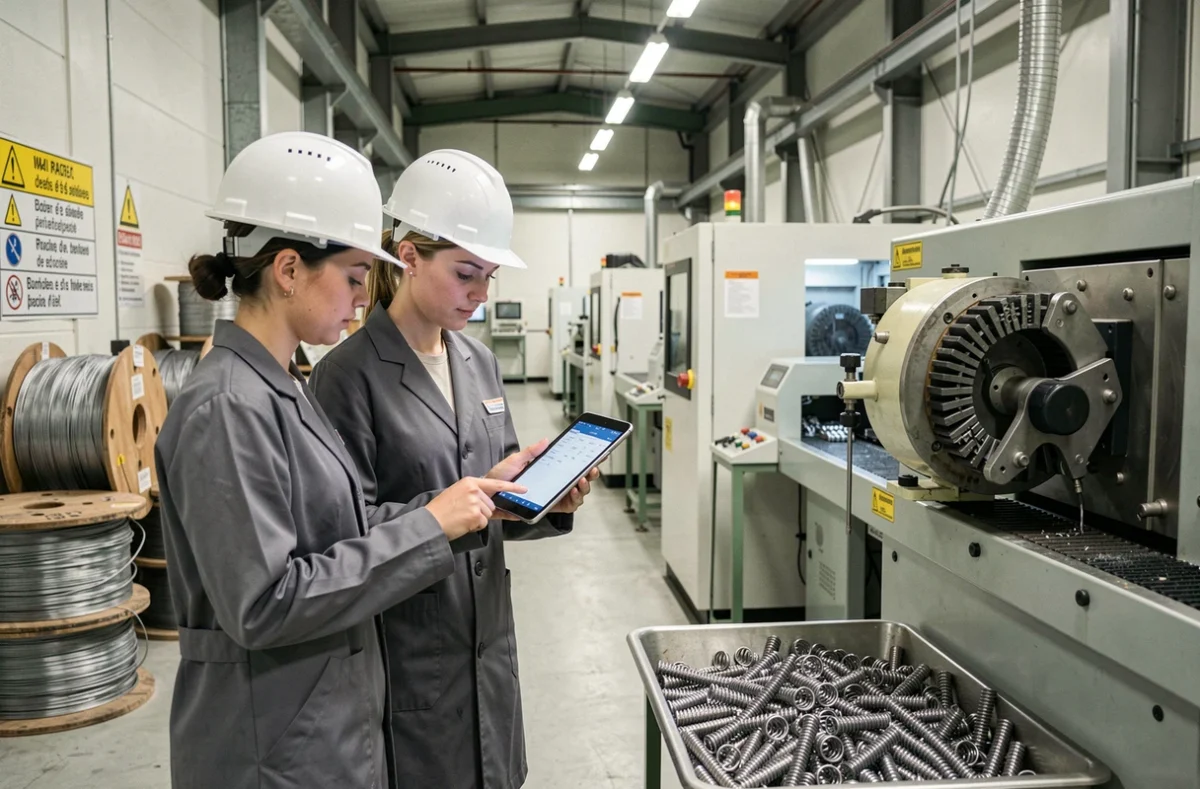
It takes more than a few weeks to train a skilled spring maker. Reading a spring drawing, setting up a coiling machine, interpreting a fatigue test: each skill takes years of hands-on experience to develop. Lost expertise can take years to rebuild, and the pool of trained candidates remains limited.
Retirements are accelerating this erosion. Some workshops rely on setup technicians who are the only ones able to operate older machines, sometimes without complete documentation. When these operators leave, production capacity for certain part numbers disappears with them.
The solution lies in documenting processes (recording setup procedures and building parameter databases) and pairing younger employees with experienced operators. The issue is not just social: it is about maintaining France’s industrial capacity in a sector where demand is shifting toward increasingly technical parts, driven by the miniaturization and electrification of systems.
Ensuring the long-term viability of a custom spring manufacturing site in France therefore means solving three challenges at once: securing raw material supplies, controlling the energy costs of heat treatments and passing on skills before they disappear. The manufacturers that succeed are not necessarily the largest, but those that anticipated these constraints ten years before they became critical.