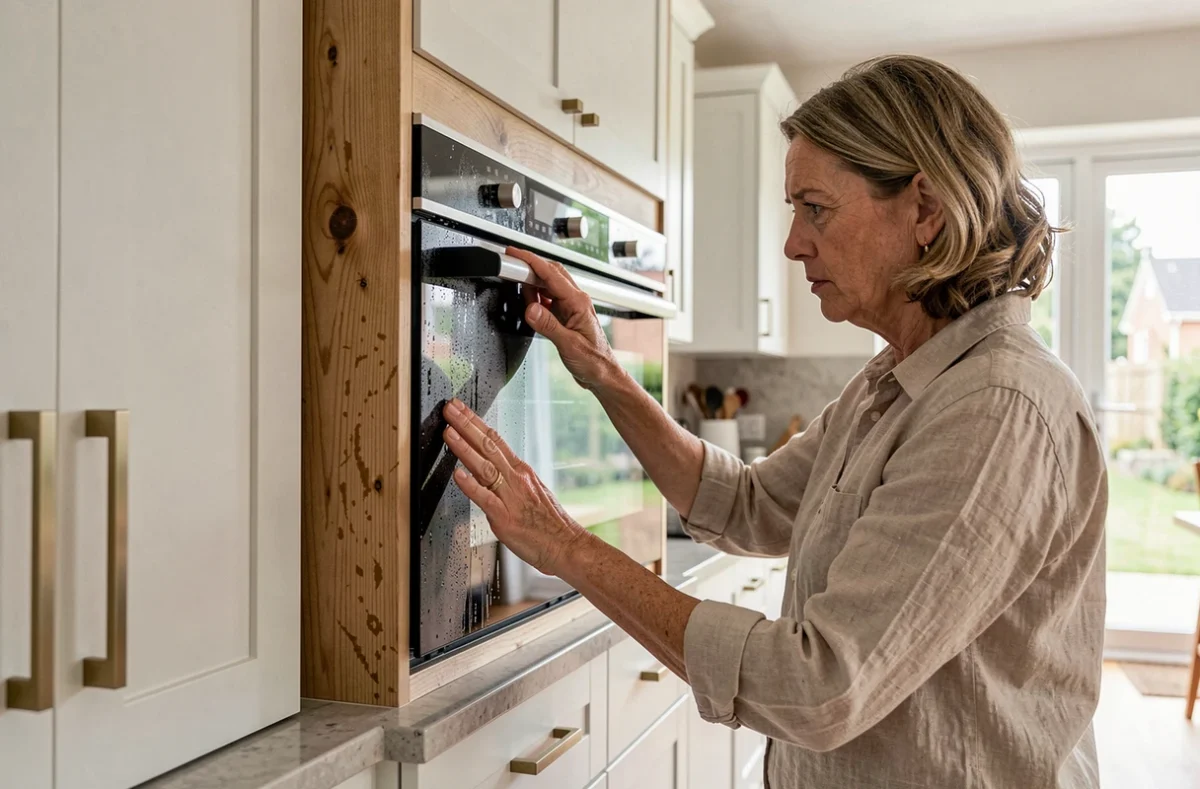
Steam ovens are becoming increasingly common in fitted kitchens, including in private homes. They work by injecting water, converted into steam, into the cooking chamber. Once the door is opened, or when steam escapes through the appliance’s vents, it comes into contact with nearby surfaces.
Kitchen cabinets, often made from melamine-faced or laminated particleboard, do not cope well with repeated exposure to moisture. The risk is not merely cosmetic: a swollen panel or peeling edge banding can compromise the cabinet’s structure.
Cooking steam and cleaning steam: two distinct sources of moisture
Discussions about steam ovens often conflate two different phenomena. The first is steam produced while cooking food, which escapes every time the door is opened and, on some models, through vents on the front or top of the appliance. The second is steam generated inside the oven during hydrolysis cleaning cycles.
The effects on cabinets are not the same. Cooking steam is frequent—sometimes daily—and spreads through the interior of the tall cabinet or adjacent unit. Cleaning steam is less frequent, but it can saturate the surrounding air if the room is poorly ventilated. A guide to the impact of steam ovens on kitchen cabinets explains these mechanisms for different types of installation.
The manufacturer’s installation instructions should specify where the model vents steam and whether a particular clearance is required around the appliance. These requirements vary from one model to another, so applying the instructions for one appliance to another is a common mistake.
Airflow inside the cabinet: an installation requirement, not an option
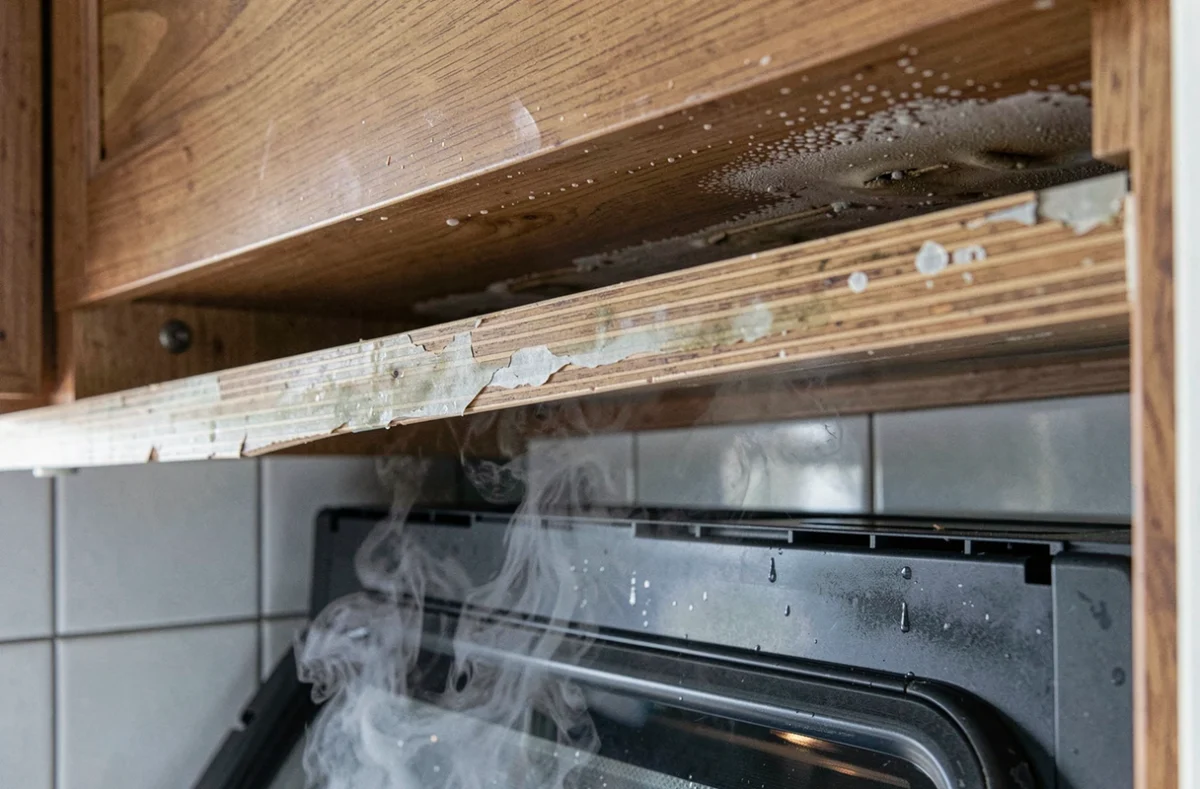
A steam oven built into a tall cabinet or installed under a countertop operates in a semi-enclosed space. Without sufficient airflow, moisture becomes trapped and damages the panels from the inside. The back panel and the top of the cabinet are the most exposed areas.
Installation guides from some manufacturers (Miele, for example, for built-in appliances) specify minimum vent opening sizes and clearances to ensure airflow. These figures are not merely decorative. An installer who fits the oven without observing these measurements creates a condensation trap.
What to check before installation
- Does the manual for the exact model specify mandatory ventilation openings in the cabinet or tall unit? Their size and position must be followed to the millimetre
- Is the back panel removable or perforated to allow airflow? Some standard cabinets come with a solid back panel that blocks all natural ventilation
- Will components that require periodic maintenance (water tank, filter, drip tray) remain accessible once the oven is installed? A door or back panel that blocks access makes it harder to spot a leak or moisture buildup
Covering maintenance access with a fixed panel is the surest way to discover damage too late.
Cabinet materials: not all respond to steam in the same way
Particleboard, the most common material in standard kitchens, is the most vulnerable. Water penetrates through the edges, hinge holes and unprotected cut-outs. Swelling is irreversible: once the panel has absorbed water, it will not return to its original shape.
MDF (medium-density fibreboard) is somewhat more resistant to occasional moisture, but remains vulnerable to prolonged exposure. Only moisture-resistant panels offer significant tolerance, and even they are not waterproof.
Solid wood, if properly varnished or oiled, handles changes in humidity better. However, it can still warp (causing doors to bow) if exposure is uneven—that is, if steam reaches one side while the other remains dry.
Targeted protection around the oven
A few measures can reduce direct exposure on the most vulnerable surfaces:
- Apply food-grade silicone sealant to the unprotected edges and cut-outs of panels next to the oven, especially on top of the cabinet
- Fit an aluminium sheet or vapour barrier film to the inside of the panel directly above the appliance, where condensation forms first
- Periodically check the condition of the heat-bonded edge banding: if it starts to peel, moisture can enter the core of the panel directly
- Always wipe away visible condensation on the cabinet walls after using the oven’s steam mode
Steam oven maintenance: how it also protects your cabinets
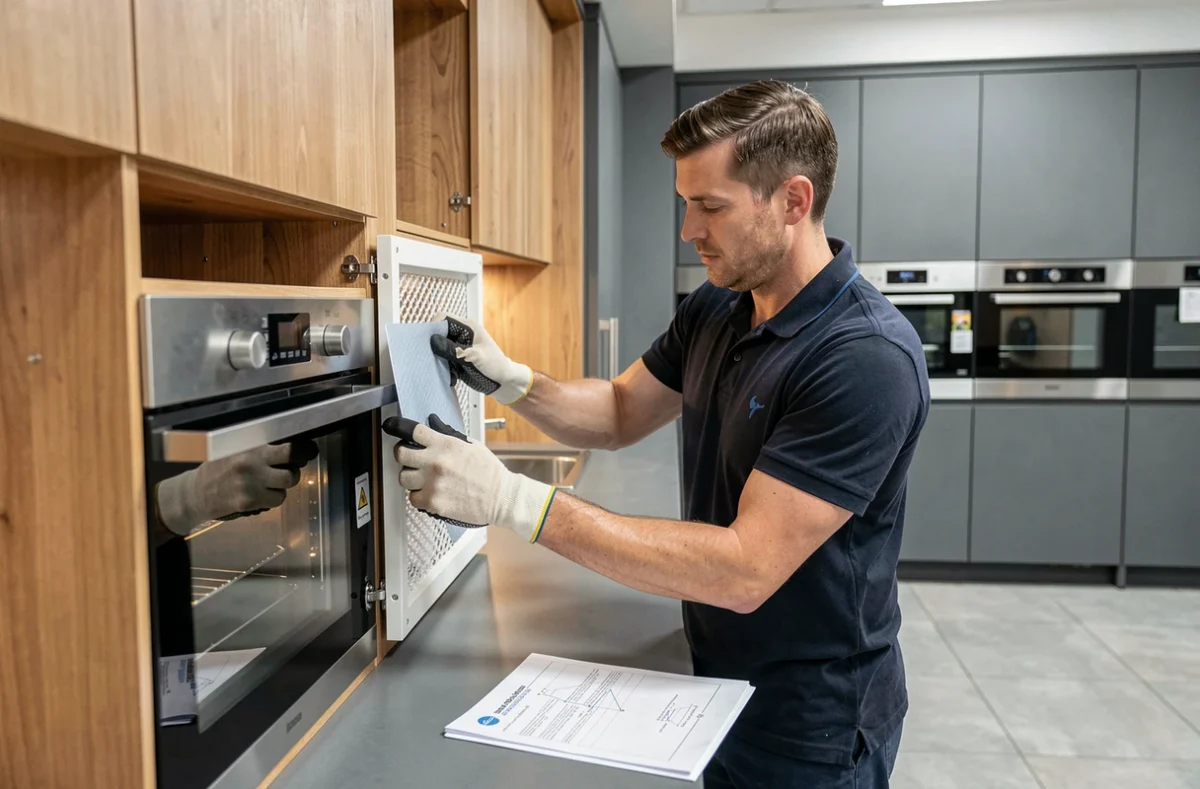
Regularly descaling the steam system is not just a matter of cooking performance. A scaled-up system can cause leaks around internal seals, allowing water to drain into the cabinet. How often you need to descale depends on the local water hardness and how frequently the oven is used. Some models indicate when descaling is needed; others do not.
The water used in the tank also matters. Depending on the model, manufacturers generally recommend filtered tap water or demineralised water. Using water that is too hard accelerates scale buildup and increases the risk of small leaks.
After each steam cooking cycle, leaving the oven door ajar for a few minutes allows residual moisture to escape into the room rather than into the cabinet. This simple step helps limit condensation on the cabinet walls.
Kitchen ventilation: an often-overlooked factor
Running an extractor hood while using the steam oven and afterwards reduces the amount of moisture in the surrounding air. Ducted systems are more effective at removing water vapour than recirculating hoods. In open-plan kitchens, steam disperses more widely, which can reduce local moisture levels around the cabinets, but does not solve the problem inside the cabinet.
Mechanical ventilation in the room does not replace ventilation inside the cabinet. The two work together. A closed cabinet with no ventilation opening will remain damp even in a well-ventilated kitchen, because hot, moisture-laden air stays trapped behind the cabinet door.
Steam buildup inside a kitchen cabinet is not always immediately visible. The first signs often appear along the edges and inside corners, as slight swelling or darker patches on the panel. Inspecting these areas every few months, especially during the first year of using the oven, makes it possible to act before the damage becomes structural.