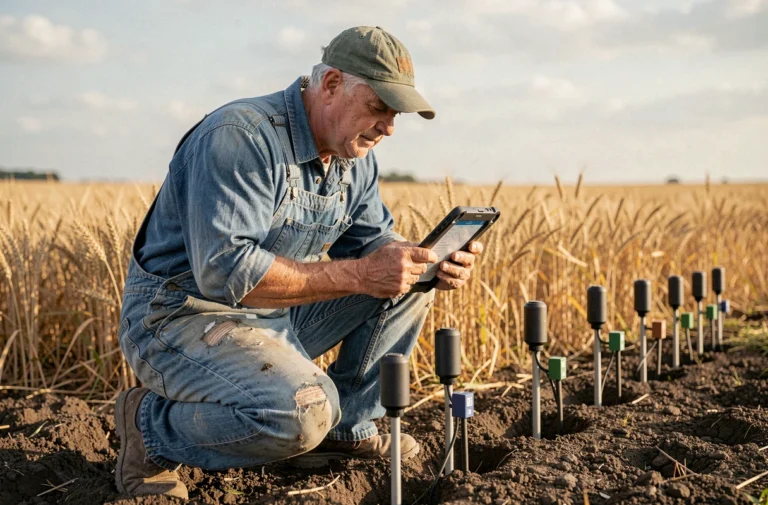
In the world of agriculture and construction, soil quality is crucial. Its conductivity, or its ability to conduct electricity, is an essential indicator of this quality. This is why the use of an ohmmeter, an electrical measuring device, has become common to assess soil resistance. This practical guide presents a simplified approach to carry out this essential measurement, whether you are a farmer, builder, or simply a homeowner looking to evaluate the quality of your soil. It will help you understand how the ohmmeter works and how to use it to obtain accurate results.
Importance of Testing Soil Conductivity
After understanding what soil conductivity is and its importance, it is relevant to ask the following question: how to measure the soil?
This process may seem confusing at first glance. However, with the right tool – an ohmmeter – and the appropriate instructions, it becomes simple to perform. Here’s how you can proceed to obtain an accurate measurement.
First, ensure that your land is in favorable conditions for this operation. This means it should be free of excessive vegetation or any other materials that might interfere with the ohmmeter. It is also preferable for the soil to be moist but not saturated with water to achieve precise results.
Next, set up the stakes provided with your ohmmeter in the ground. They should be planted a certain distance apart according to the instructions given by the manufacturer of your device.
Once these stakes are correctly installed, connect them to the corresponding cables on your ohmmeter and then turn it on. Allow the device a few moments to take its readings before recording your results.
It should be noted that each reading may vary depending on weather conditions (temperature and humidity) as well as the specific mineral composition of the tested soil. To correctly interpret the values obtained during the process of ‘how to measure the soil’, refer to the standards governing your field of activity or consult a qualified professional.
To summarize: measuring the electrical resistance or conductivity of a plot involves several steps ranging from preparation to the final interpretation of the results collected using a modern digital ohmmeter.
Never forget that understanding ‘how to measure the soil’ is not only an essential means to evaluate its agronomic quality but also to ensure our safety against certain common electrical risks.
Understanding Soil Conductivity
In the field of soil resistance measurement, there are different types of ohmmeters available. Each has its own characteristics and is suitable for specific uses.
There are analog ohmmeters, also known as galvanometers. They consist of a needle that moves across a graduated scale based on the measured value. Although these devices are simpler for non-experts to use, they offer limited accuracy and often require frequent calibration.
We also have portable digital ohmmeters. These modern devices allow for quick and accurate readings of soil resistance values. They are equipped with an LCD screen that displays results directly in numbers rather than moving needles. Some models even offer additional functions such as data recording or Bluetooth connectivity to easily transfer measurements to another device.
It should also be noted that there are specialized ohmmeters for certain specific fields such as agriculture or industrial electricity. For example, for those working in the agricultural sector, there are ohmmeters with underground probes specifically designed to measure electrical conductivity in the soil to assess its fertility.
To choose the right type of ohmmeter suited to your specific needs, consider several criteria such as:
• The measurement range: some ohmmeters are better suited for soils with low resistance, while others are designed to measure higher values.
• Accuracy: it is advisable to choose a device that offers sufficient accuracy for your needs. It is also important to consider that accuracy may vary depending on atmospheric conditions and soil composition.
• The ease of use: opt for an ohmmeter that provides a user-friendly and intuitive interface to facilitate the use and interpretation of results.
The Different Types of Ohmmeters for Measuring Conductivity
Once equipped with the appropriate ohmmeter, you are ready to proceed with the measurement of soil resistance. Here are the key steps to carry out this operation.
Ensure that your device is properly calibrated and functioning under optimal conditions. Also, check if the probes or stakes are clean and free of any dirt or corrosion that could affect measurement accuracy.
Choose the location where you want to perform your measurement. It is recommended to select several points scattered across the land to obtain a representative average. Avoid areas near metallic objects that may influence the results.
When you have identified your locations, carefully drive the probes into the soil until they reach a sufficient depth. You may also use a soft hammer to facilitate their insertion without damaging the device.
Once your probes are in place, connect them to the appropriate terminals of the ohmmeter and check that there are no weak or loose connections that could alter the final measurements.
At this stage, turn on your ohmmeter and allow it to stabilize for a few moments to obtain a precise and stable reading. Ensure that all necessary parameters are correctly configured (measurement range, units used) before you begin recording your data.
Once you are ready, take the measurements, being careful to note each value corresponding to the specific location on your land. To obtain more reliable results, it is recommended to repeat the measurements several times and calculate an average.
After obtaining all your values, evaluate the soil resistance by analyzing the recorded numbers. Compare them to reference values or standards in your sector to determine if your land is conductive or not.
It is important to keep in mind that certain factors can influence these results, such as the chemical composition of the soil, the moisture level, or the presence of disruptive elements like roots or rocks.
Measuring soil resistance with an ohmmeter requires a precise and rigorous approach. By following the steps outlined in this practical guide, you will be able to obtain relevant information regarding the electrical conductivity of your land. This data will be useful for various fields such as agriculture, construction, or the installation of secure electrical systems.
Measuring Soil Resistance with an Ohmmeter
Once you have obtained the soil resistance measurements at different locations, it is time to interpret these results and analyze the electrical conductivity of your land.
It should be noted that soil conductivity can vary depending on several factors. The chemical composition of the soil plays a crucial role in its ability to conduct electricity. Mineral-rich soils such as sand or clay generally have better electrical conductivity than those composed primarily of organic matter.
The moisture level of the soil also has a significant impact on its conductivity. Moist soil promotes better electrical conduction because water acts as a conductor. Conversely, dry soil presents a higher resistance and thus lower conductivity.
By analyzing the measurements obtained with your ohmmeter, you can compare the recorded values to the standards in your sector.
Analyzing Results and Interpreting Soil Conductivity
Once you have obtained the soil resistance measurements at different locations, it is time to interpret these results and analyze the electrical conductivity of your land.
It should be noted that soil conductivity can vary depending on several factors. The chemical composition of the soil plays a crucial role in its ability to conduct electricity. Mineral-rich soils such as sand or clay generally have better electrical conductivity than those composed primarily of organic matter.
The moisture level of the soil also has a significant impact on its conductivity. Moist soil promotes better electrical conduction because water acts as a conductor. Conversely, dry soil presents a higher resistance and thus lower conductivity.
By analyzing the measurements obtained with your ohmmeter, you can compare the recorded values to the current standards in your sector. This will allow you to assess whether the conductivity of your land falls within acceptable limits to ensure proper functioning of electrical installations related to the system in place.
Measuring soil resistance is also important when it comes to saving energy.
Practical Applications of Soil Conductivity Measurement
Accurate knowledge of soil conductivity allows for optimizing the efficiency of grounding systems and reducing electromagnetic disturbances. Indeed, excessive resistance can lead to problems such as surges or interference in electrical circuits.
When evaluating the conductivity of your soil, you must take into account the environmental factors. For example, if your land is located near a water source such as a river or lake, this can significantly influence its conductivity.