
The market for thermal brush cutters is no longer just a race for engine displacement. Since the implementation of Regulation (EU) 2016/1628 on emissions from non-road engines (Stage V), manufacturers are reformulating their ranges. “Stage V ready” models display reduced levels of particulate matter and nitrogen oxides compared to previous generations.
At the same time, several municipalities are restricting the time slots for using thermal machines in residential areas. Noise level is now at the center of selection criteria, sometimes even ahead of raw power.
Noise and emissions regulations: what changes for a thermal brush cutter in 2025
The European regulation 2016/1628, fully applicable to small displacements since 2021, has concrete effects in stores. Some models from old stocks remain available at reduced prices but do not comply with the latest emission standards. A Stage V compliant engine costs more to purchase; however, its resale value and regulatory longevity are better.
Comparators like top-debroussailleuse-thermique.com allow filtering models based on their compliance, which helps avoid buying a device whose use will be gradually restricted in certain municipalities.
On the noise side, municipal decrees have been multiplying since 2023. The Ministry of Ecological Transition has updated its guide “Neighborhood Noise and Gardening,” and the Association of Mayors of France is relaying model decrees that limit the use of noisy thermal machines, often to weekday mornings and short time slots on weekends. The noise level is becoming as significant a purchasing criterion as power.
2-stroke or 4-stroke engine: beyond fuel
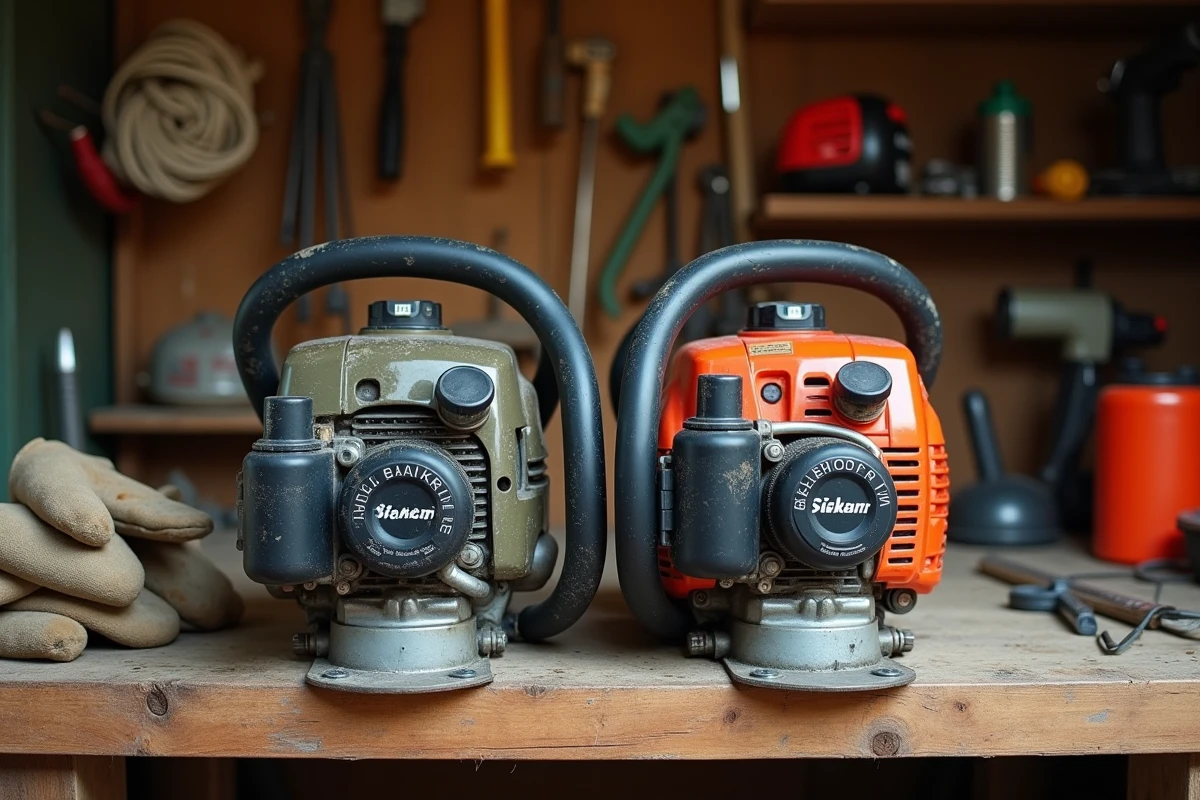
The choice between a 2-stroke and a 4-stroke engine is not limited to the question of oil-gasoline mixture. The two architectures differ in weight, vibrations, low-end torque, and maintenance.
A 2-stroke engine is lighter at equivalent displacement, which matters when carrying the device for several hours. It delivers a quick torque, suitable for brambles and dense grasses. However, it vibrates more and consumes more fuel per hour of operation.
A 4-stroke engine runs at a more stable speed, generates fewer vibrations, and more easily meets Stage V emission thresholds. Its greater weight can be tiring over long sessions. The 4-stroke is better suited for large areas with regular vegetation, while the 2-stroke remains preferred for occasional interventions on wastelands.
Displacement and power: reading beyond the numbers
Displacement, expressed in cm3, gives an indication of the engine’s raw power. Field feedback varies on this point: a high displacement does not guarantee a better result if the cutting system or transmission does not keep up. An engine well-sized for the type of vegetation encountered will always be more efficient than an oversized engine that weighs down the machine and accelerates user fatigue.
Cutting system of a brush cutter: line, blade, or disc
The cutting system determines the versatility of the machine more than any other component. Three families coexist, and the right choice directly depends on the vegetation to be managed.
- The nylon line head is suitable for soft grasses, mowing finishes, and edges. The line wears out quickly on brambles and woody stems, requiring frequent recharges.
- The three or four-tooth blade tackles brambles, young shrub shoots, and semi-woody vegetation. It requires a well-adjusted harness to control the jolts.
- The tungsten disc is for heavy-duty work: thick underbrush, small trunks. Its weight and inertia require a robust conical torque and a professional harness.
Many users buy a brush cutter with only one cutting head and discover too late that their terrain requires another accessory. Checking the machine’s compatibility with several cutting systems before purchase avoids this deadlock.

Harness, handle, and pole: comfort that determines work quality
A powerful engine mounted on a poorly balanced pole produces mediocre work and muscle pain. The harness and handle are just as important as the engine in the final result.
The bicycle-type handle offers precise lateral control, suitable for flat terrains and large areas. The loop handle, more compact, facilitates work on slopes and in cluttered areas. The choice depends more on the terrain’s topography than on personal preference.
Pole and transmission: details that last
The length of the pole influences the working radius and fatigue. A pole that is too short forces bending, while a pole that is too long destabilizes the machine. Models with adjustable poles allow adapting the length to the user’s height.
The transmission (rigid shaft or flexible cable) affects long-term reliability. A rigid shaft transmits torque better and supports heavy blades, while a flexible cable reduces vibrations but limits compatibility with cutting discs.
Maintenance of a thermal brush cutter: what prolongs its lifespan
The longevity of a thermal brush cutter depends on simple actions, often neglected. A clogged air filter reduces engine efficiency and increases consumption. The spark plug, inexpensive, deserves regular replacement rather than a rough cleaning.
- Clean the air filter after each prolonged session, especially in dusty conditions
- Check the tension and condition of the line or the sharpening of the blade before each use
- Drain the fuel at the end of the season to avoid clogging the carburetor
- Check the conical torque and grease it according to the manufacturer’s recommendations
Regular maintenance costs less than repairing a clogged carburetor. The available data do not allow for a universal average lifespan, as it varies according to usage intensity and maintenance quality.
The choice of a thermal brush cutter relies on a balance between engine power, a cutting system suited to the vegetation, and user comfort. Compliance with emission standards and local noise restrictions adds a layer of complexity that traditional buying guides underestimate. Testing the actual weight of the machine when harnessed, checking compatibility with several cutting heads, and consulting the decrees of one’s municipality before purchase remain the three most useful reflexes.